| |
|
|
|
|
|
|
Galaxy Picture Gallery |
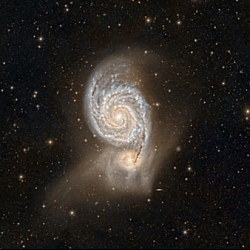
Massive, gravitationally bound system consisting of stars, an interstellar medium of gas and dust, and dark matter.
Typical galaxies range from dwarfs with as few as ten million stars up to giants with one trillion stars, all orbiting a common center of mass. Galaxies can also contain many multiple star systems, star clusters, and various interstellar clouds.
Historically, galaxies have been categorized according to their apparent shape (usually referred to as their visual morphology). A common form is the elliptical galaxy, which has an ellipse-shaped light profile. Spiral galaxies are disk-shaped assemblages with curving, dusty arms. Galaxies with irregular or unusual shapes are known as peculiar galaxies, and typically result from disruption by the gravitational pull of neighboring galaxies. Such interactions between nearby galaxies, which may ultimately result in galaxies merging, may induce episodes of significantly increased star formation, producing what is called a starburst galaxy. Small galaxies that lack a coherent structure could also be referred to as irregular galaxies.
There are probably more than one hundred billion (10E11) galaxies in the observable universe. Most galaxies are 1,000 to 100,000 parsecs in diameter and are usually separated by distances on the order of millions of parsecs (or megaparsecs). Intergalactic space (the space between galaxies) is filled with a tenuous gas of an average density less than one atom per cubic metre. The majority of galaxies are organized into a hierarchy of associations called clusters, which, in turn, can form larger groups called superclusters. These larger structures are generally arranged into sheets and filaments, which surround immense voids in the universe.
Although it is not yet well understood, dark matter appears to account for around 90% of the mass of most galaxies. Observational data suggests that supermassive black holes may exist at the center of many, if not all, galaxies. They are proposed to be the primary cause of active galactic nuclei found at the core of some galaxies. The Milky Way galaxy, home of Earth and the solar system, appears to harbor at least one such object within its nucleus.
|
|
| |
|
Andromeda |
M31 - Andromeda Galaxy (nucleus)
YEAR: 2026
|
M31 - Andromeda Galaxy - FIST LIGHT
YEAR: 2024
|
ARP273
YEAR: 2021
|
M31 - Andromeda Galaxy
YEAR: 2016
|
M31 - Andromeda Galaxy
YEAR: 2010
|
NGC891 area
YEAR: 2010
|
M31 - Andromeda Galaxy
YEAR: 2007
|
| |
|
Canes Venatici |
 M63 - NGC5055 - Sunflower Galaxy
YEAR: 2026
|
M51 - NGC5194 - Whirlpool Galaxy
YEAR: 2026
|
NGC4631 - Whale Galaxy, RGB Color
YEAR: 2025
|
M51 - NGC5194 - Whirlpool Galaxy
YEAR: 2013
|
Supernova SN2011dh animation - M51
YEAR: 2011
|
NGC4631 - Whale Galaxy
YEAR: 2011
|
M51 - NGC5194 - Whirlpool Galaxy
YEAR: 2011
|
M51 - NGC5194 - Whirlpool Galaxy
YEAR: 2008
|
M51 - NGC5194 - Whirlpool Galaxy
YEAR: 2007
|
| |
|
Cepheus |
ARP29 - NGC6946 - Fireworks Galaxy
YEAR: 2021
|
| |
|
Coma Berenices |
NGC4565 - Needle Galaxy
YEAR: 2013
|
M64 - Black Eye Galaxy
YEAR: 2012
|
| |
|
Leo |
NGC2903
YEAR: 2012
|
NGC2903
YEAR: 2012
|
Hickson Galaxy Group H44
YEAR: 2011
|
M96 - NGC3368
YEAR: 2011
|
M65 and M66 - Leo Triplet
YEAR: 2009
|
M65, M66 & NGC3628 - The Leo Triplet (NW)
YEAR: 2008
|
M65, M66 & NGC3628 - The Leo Triplet (ED)
YEAR: 2008
|
| |
|
Pegasus |
NGC7331 & Stephan's Quintet
YEAR: 2026
|
Stephan's Quintet
YEAR: 2025
|
NGC7331 - the Milky Way's twin
YEAR: 2012
|
NGC7479
YEAR: 2012
|
| |
|
Pisces |
M74 - NGC 628 - Phantom Galaxy
YEAR: 2018
|
NGC474 - NGC470
YEAR: 2012
|
| |
|
Triangulum |
M33 - NGC598 - Triangulum Galaxy
YEAR: 2025
|
M33 - NGC598 - Triangulum Galaxy (v3)
YEAR: 2009
|
M33 - NGC598 - Triangulum Galaxy (v2)
YEAR: 2008
|
M33 - NGC598 - Triangulum Galaxy (v1)
YEAR: 2007
|
| |
|
Ursa Major |
Owl Nebula (& Surfboard Galaxy)
YEAR: 2026
|
M108 (& Owl Nebula)
YEAR: 2026
|
M81/M82 - NGC3031/NGC3034 - Bode's Galaxy (v2)
YEAR: 2014
|
M81/M82 - NGC3031/NGC3034 - Bode's Galaxy
YEAR: 2014
|
Supernova SN2011by - NGC3972
YEAR: 2011
|
M81 - NGC3031 - LRGB Combination
YEAR: 2011
|
M101 - NGC5457 - Pinwheel Galaxy (LRGB)
YEAR: 2011
|
M101 - NGC5457 - Pinwheel Galaxy
YEAR: 2010
|
M81/M82 - NGC3031/NGC3034 - Bode's Galaxy
YEAR: 2009
|
M82 - NGC3034 - Cigar Galaxy
YEAR: 2008
|
M82 - NGC3034 - Cigar Galaxy
YEAR: 2006
|
| |
|
Virgo |
Supernova SN2022hrs - NGC4647
YEAR: 2022
|
NGC4424 & SN2012cg
YEAR: 2012
|
M84-M86 Galaxies Cluster - Widefield
YEAR: 2008
|
M104 - NGC4594 - Sombrero Galaxy Widefield
YEAR: 2008
|
M104 - NGC4594 - Sombrero Galaxy
YEAR: 2008
|
| |