The dark dust lane and the bulge give this galaxy the appearance of a sombrero. The galaxy has an apparent magnitude of 9.0, making it a galaxy that can easily be seen with amateur telescopes. The large bulge, the central supermassive black hole, and the dust lane all attract the attention of professional astronomers.
Charles Messier made a hand-written note about this and five other objects (now collectively recognized as M104 - M109) to his personal list of objects now known as the Messier Catalogue, but it was not "officially" included until 1921. William Herschel independently discovered the object in 1784 and additionally noted the presence of a "dark stratum" in the galaxy's disk, what is now called a dust lane.
As noted above, this galaxy's most striking feature is the dust lane that crosses in front of the bulge of the galaxy. This dust lane is actually a symmetric ring that encloses the bulge of the galaxy. Most of the cold atomic hydrogen gas and the dust lies within this ring
In the 1990s, a research group demonstrated that a supermassive black hole is present within the Sombrero Galaxy. Using spectroscopy data from both the CFHT and the Hubble Space Telescope, the group showed that the speed of rotation of the stars within the center of the galaxy could not be maintained unless a mass 1 billion times the mass of the Sun, or 109M☉, is present in the center. This is among the most massive black holes measured in any nearby galaxies. At radio and X-ray wavelengths, the nucleus is a strong source of synchrotron emission.
In 2006, two groups published measurements of the submillimeter radiation from the nucleus of the Sombrero Galaxy at a wavelength of 850 micrometres. The source of the submillimeter emission remains unidentified.
The Sombrero Galaxy has a relatively large number of globular clusters. Observational studies of globular clusters in the Sombrero Galaxy have produced estimates of the population in the range of 1200 to 2000. The ratio of the number of globular clusters to the total luminosity of the galaxy is high compared to the Milky Way and similar galaxies with small bulges, but the ratio is comparable to other galaxies with large bulges.
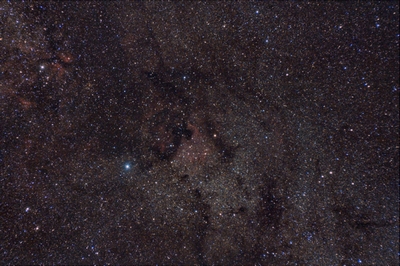
This widefield picture shows the surrounding area of Sobrero Galaxy. |
|