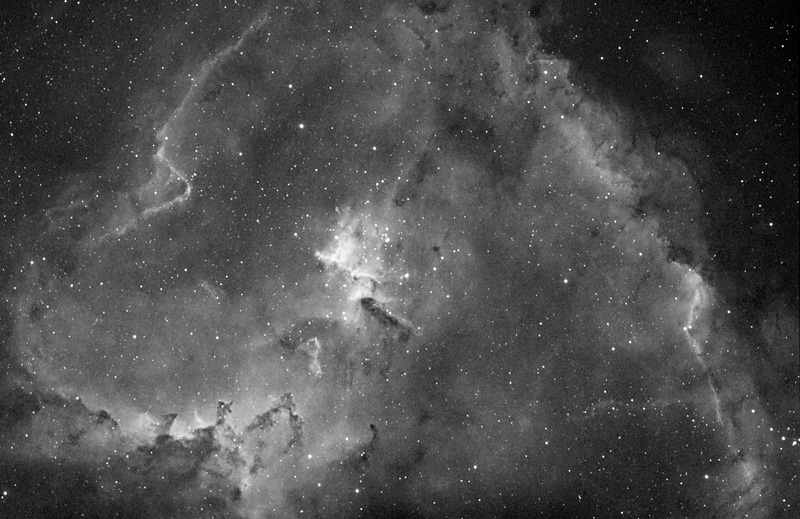
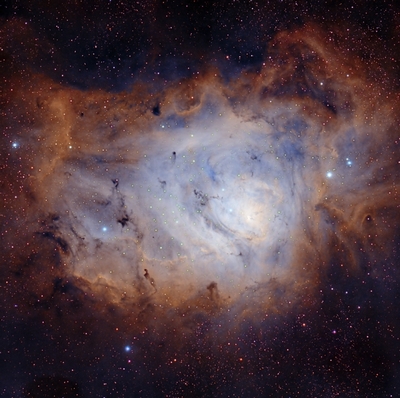
IC1805 - Heart Nebula (Ha)
Cassiopeia
2.6 hours exposure of central heart nebula in H-alpha
|
| |
he Heart Nebula, IC 1805, lies some 7500 light years away from Earth and is located in the Perseus arm of the Galaxy in the constellation Cassiopeia. This is an emission nebula showing glowing gas and darker dust lanes. The nebula is formed by plasma of ionized hydrogen and free electrons.
The picture show the central part of this wide nebula (with aparent size of 5 times the diameter of full moon). Does not include the very brightest part of this nebula classified as NGC 896.
The nebula's intense red output and its configuration are driven by the radiation emanating from a small group of stars near the nebula's center. This open cluster of stars known as Melotte 15 contains a few bright stars nearly 50 times the mass of our Sun, and many more dim stars that are only a fraction of our Sun's mass. The cluster used to contain a microquasar that was expelled millions of years ago.
IC 1805 (the Heart nebula) is also sometimes called the 'Running Dog nebula' because it is said to resemble a running dog when viewed through a telescope. |
|
| |
| Technical details: |
|
Location: |
Valdemorillo - Spain |
Date: |
04/10/2009 (dd/mm/yyyy) |
Conditions: |
Bad |
Temperature: |
17ºC |
Humidity: |
51 |
|
|
Telescope: |
GSO Reflector 200mm f/4 |
Reducer/corrector: |
Baader MPCC |
Filter: |
Baader Ha 7nm 2" |
Mount: |
Meade LXD Autostar |
Camera: |
Canon 350D no filter |
Exposure: |
16 x 600s @ 800ISO |
Guiding tube: |
B&C 60/350 f7 |
Guiding camera: |
Meade DSI Pro |
Guiding software: |
PHD Guiding |
|
|
Procesing: |
Procesado estandard. Segundo intento para eliminar los artifacts negros que aparecieron en la primera toma. |
|
Notes: |
Full moon.
Light high clouds, no good transparency. |
|
|
|
|