The Veil Nebula, also known as the Cygnus Loop or the Witch's Broom Nebula, is a large, relatively faint supernova remnant in the constellation Cygnus. The source supernova exploded some 5,000 to 8,000 years ago, and the remnants have since expanded to cover an area of 3 degrees. The distance to the nebula is not precisely known, with estimates ranging from 1,400 to 2,600 light-years.
It was discovered on 1784 by William Herschel. He described the western end of the nebula as "Extended; passes thro' 52 Cygni... near 2 degree in length." and described the eastern end as "Branching nebulosity... The following part divides into several streams uniting again towards the south."
Eastern Veil (NGC 6992/95)
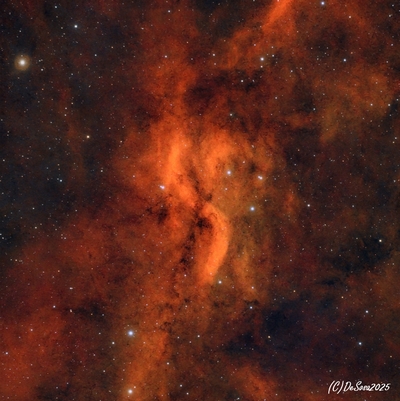
Pickering's(Fleming's) Triangular Wisp (NGC 6979)
Western Veil (NGC 6960)
When finely resolved, some parts of the image appear to be rope like filaments. The standard explanation is that the shock waves are so thin, less than one part in 50,000 of the radius, that the shell is only visible when viewed exactly edge-on, giving the shell the appearance of a filament. Undulations in the surface of the shell lead to multiple filamentary images, which appear to be intertwined.
The nebula is notorious among astronomers for being difficult to see visually, even though it has a bright integrated magnitude of 7. However, using an UHC or OIII filter will allow an observer to see the nebula clearly.
The brighter segments of the nebula are listed in the New General Catalog under the designations NGC 6960, 6962, 6979, 6992, and 6995. The easiest segment to find is 6960, which runs through the naked eye star 52 Cygni. NGC 6979 - the central portion of the Veil Complex is Pickering's Wedge, or Pickering's Triangular Wisp. This segment of nebulosity was discovered photographically by Williamina Fleming, but credit went to her supervisor Edward Pickering, as was the custom of the day, thus named after Pickering as a result. |
|