M8 - NGC6523 - Lagoon Nebula (II)
Sagittarius
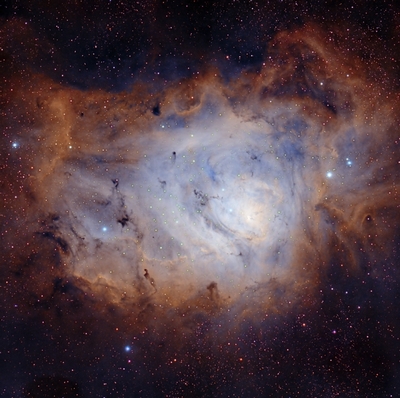
Giant interstellar cloud and H II region (alternative processing)
|
| |
At an estimated distance of 4,100 light-years, the Lagoon is one of only two star-forming nebulae faintly visible to the naked eye from mid-northern latitudes. The nebula has a fragile star cluster superimposed on it, making this one of the leading celestial sights of summer night skies.
The Lagoon Nebula spans 90' by 40' on the sky which, at its calculated distance of 4,100 light years, translates to an actual dimension of 110 by 50 light years. The nebula contains a number of globules, dark, collapsing clouds of protostellar material, the most prominent of which have been catalogued by E. E. Barnard as numbers B88, B89 and B296. It also includes a funnel-like structure or a tornado caused by a hot o-type star that pours out ultraviolet light that heats up and ionizes gases on the surface of the nebula. Combined with the heat and pressure of the starlight it twists and shears the wind into a funnel-like structure.
It also contains the so-called "Hourglass Nebula" (so named by John Herschel) in its central area, though this particular nebula is not related to the more commonly referenced Hourglass Nebula which lies in the southern constellation of Musca.
It was discovered by Guillaume Le Gentil in 1747.
In 2006 the first four Herbig-Haro objects were detected in the hourglass region of M8 also including HH 870. This provides the first direct evidence of active star formation by accretion in M8. |
|
| |
| Technical details: |
|
Location: |
Guadalupe - Cáceres - Spain |
Date: |
05/07/2008 (dd/mm/yyyy) |
Conditions: |
Normal |
Temperature: |
20ºC |
Humidity: |
low |
|
|
Telescope: |
Long Perng ED80 f/6.9 |
Reducer/corrector: |
No reducer |
Filter: |
IDAS LPS 2" |
Mount: |
Vixen GPD2 Autostar Meade |
Camera: |
Canon 350D no filter |
Exposure: |
10x600s@400ISO |
Guiding tube: |
B&C 60/350 f7 |
Guiding camera: |
Meade DSI Pro |
Guiding software: |
K3CCDTools |
|
|
Procesing: |
Calibrate, align, combined. Histogram and level adjustment. This is another procesing method for the same picture. |
|
Notes: |
Windly night. The guiding data shown +/-1 arcsec average, +/-2 arcsecs peak.
This picture was taken in one of the darkest locations in Spain (22.8), with good clear elevation over horizon, but not so good transparency.
Picture is not framed, so optics defects near the edges are clearly visible. |
|
|
|
|
|