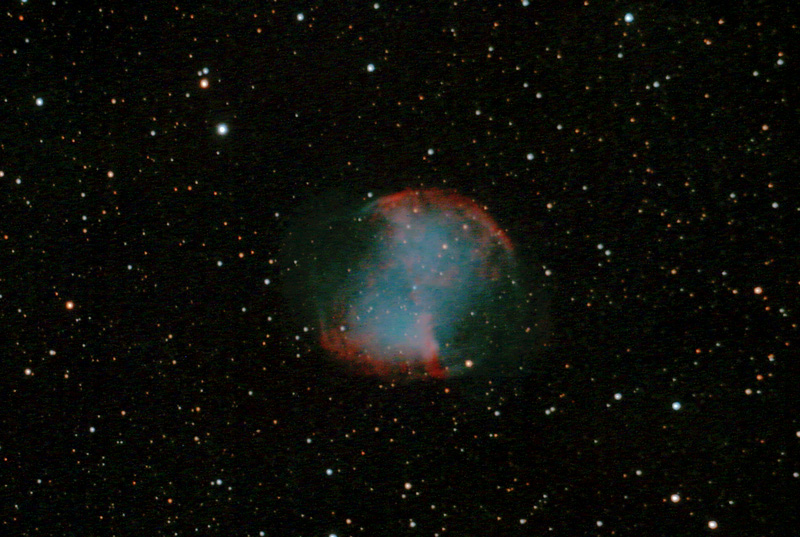
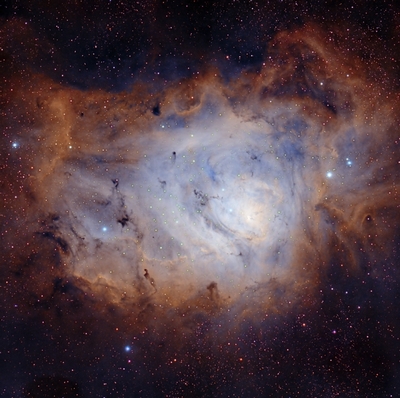
M27 - NGC6853 - Dumbbell Nebula
Vulpecula
Planetary Nebula
|
| |
M27 (NGC 6853) is the famous Dumbbell Nebula, one of the most photographed planetary nebulae in the night sky. It is located in Vulpecula at the southern end of Cygnus. Its Magnitude 7.4 visual brightness makes it easy to find even in small telescopes. It is estimated to be 1,200 light-years from Earth. The Dumbbell Nebula was discovered on 12th July 1764 by Charles Messier and was the first planetary nebula to be discovered.
Planetary nebulae are formed in the dying stages of a star when the core fusion reactions decline to the extent that the star's structure cannot be supported - gravity forces the outer part of the star to collapse inwards, causing the inner part to condense and heat up. The intense build up of pressure and radiation causes the outer shell to 'explode' and be driven away. The intense stellar wind causes the surrounding gases to ionize in bright colours. Planetary nebulae are in fact very common in our galaxy, other noteworthy examples being the Helix Nebula and the Ring Nebula, though most of them are much smaller and less significant than these examples. |
|
| |
| Technical details: |
|
Location: |
Valdemorillo - Spain |
Date: |
18/07/2007 (dd/mm/yyyy) |
Conditions: |
Good |
Temperature: |
ºC |
Humidity: |
|
|
|
Telescope: |
Meade SC8" f/10 |
Reducer/corrector: |
No reducer |
Filter: |
IDAS LPS 2" |
Mount: |
Meade LXD Autostar |
Camera: |
Canon 300D Schott filter |
Exposure: |
12x300s @ ISO800 |
Guiding tube: |
Skylux 70/700 f/10, barlow x2 |
Guiding camera: |
Celestron NexImage |
Guiding software: |
K3CCDTools |
|
|
Procesing: |
Stacked, histogram adjustment, curves and wavelets. |
|
Notes: |
Very good guiding data obtained. Clear and stable sky. |
|
|
|
|
|